
Remember the days of pulling heavy volumes from the firm’s library or agonizing over the perfect Boolean search string—hoping you didn’t miss a critical case because you typed an “OR” instead of an “AND”?
Legal research has always been the backbone of a strong case, but it has also been one of the most time-consuming parts of practicing law. Enter Artificial Intelligence (AI).
Despite the sensational headlines, AI isn’t here to replace your legal judgment or take your job. Instead, it acts as the ultimate associate—one that reads at the speed of light, never sleeps, and helps you find exactly what you need.
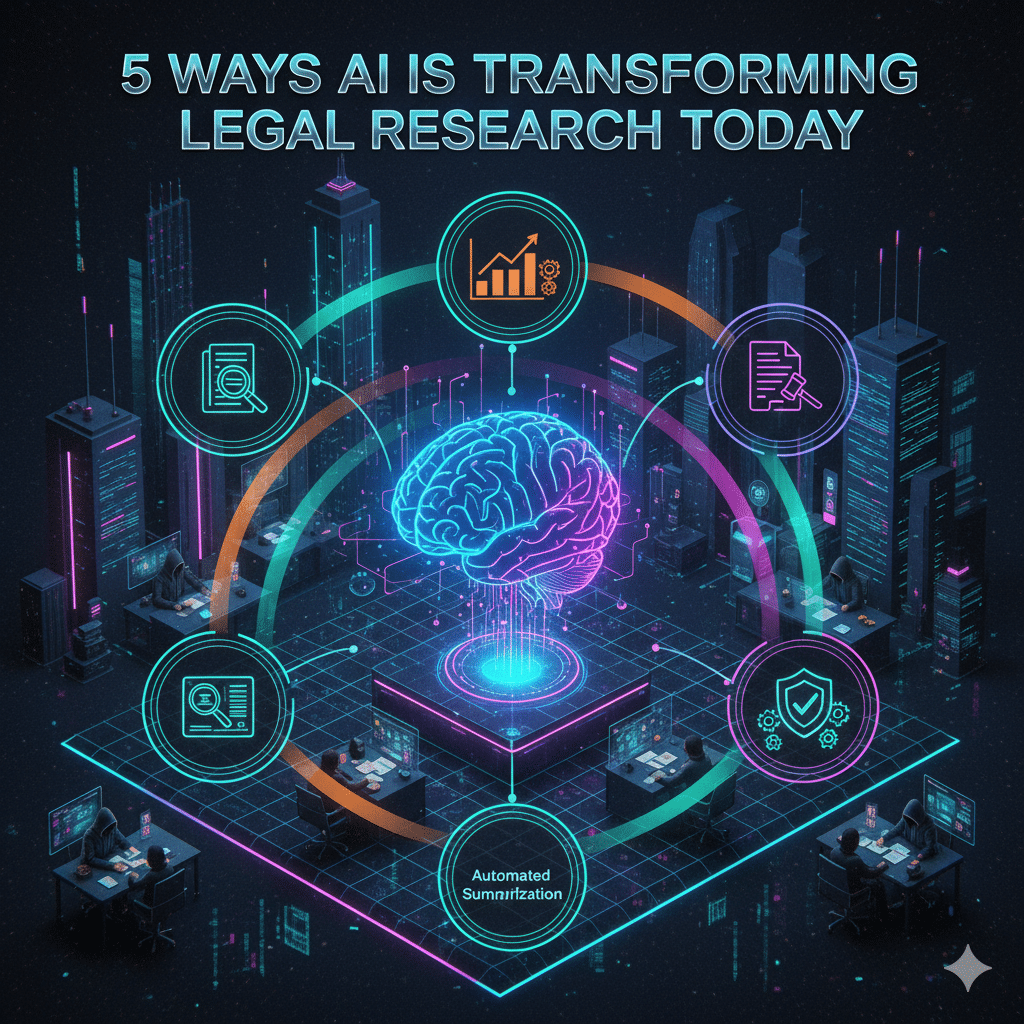
If you are wondering how to practically apply AI to your day-to-day practice, here are five easy-to-understand ways AI is transforming legal research right now.
1. Goodbye Boolean, Hello Natural Language
For decades, lawyers had to speak the language of databases. If you wanted to find a case about a landlord’s liability for a tenant’s dog, you had to type something like: (landlord OR “property owner”) /p (dog /s bite) AND liability.
Today’s AI uses Natural Language Processing (NLP). This means you can type a query into modern legal research platforms exactly how you would ask a colleague: “Can a commercial landlord in Texas be held liable if a tenant’s dog bites a customer in the parking lot?”
The AI understands the intent of your question, bypassing the need for exact keyword matches. It instantly pulls the most relevant cases, saving you from the trial-and-error of crafting the perfect search terms.
2. Instant Case Summaries and Extraction
We’ve all been there: you find a promising 60-page appellate opinion, only to read 45 pages in and realize it doesn’t actually apply to your facts.
Generative AI tools can now instantly read and summarize massive documents. Before you commit to reading a full case, AI can generate a one-paragraph summary detailing the facts, the legal issue, and the court’s holding. Some tools will even highlight the specific paragraphs most relevant to your specific query. This allows you to vet dozens of cases in the time it used to take to read just one.
3. Finding the “Needle in the Haystack” (Contextual Search)
Traditional keyword searches have a fatal flaw: if a judge used the word “vehicle” instead of “car,” your search for “car” might miss the case entirely.
AI doesn’t just look for matching words; it understands concepts and context. If you are researching “breach of contract,” the AI knows to also look for cases discussing “failure to perform,” “violation of terms,” or “non-compliance,” even if you didn’t explicitly search for those phrases. This dramatically reduces the dreaded fear of missing a critical precedent just because opposing counsel or a judge used different terminology.
4. Bulletproof Brief Analysis
Reviewing your own brief—or dissecting opposing counsel’s—is tedious work. Today, AI-powered brief analysis tools (like Casetext’s CARA or Thomson Reuters’ Quick Check) allow you to securely upload a PDF of a legal document.
In seconds, the AI scans the entire document, identifies every citation, and tells you:
-
If the cited cases are still good law (automating the Shepardizing/KeyCite process).
-
If opposing counsel is mischaracterizing a case.
-
Most importantly: Highly relevant cases that neither side included in the brief.
It’s like having an eagle-eyed senior partner review your brief before you file it, ensuring your arguments are watertight.
5. Predicting Judicial Behavior (Data-Driven Strategy)
“Know your judge” is one of the oldest rules in litigation. In the past, this meant relying on firm lore, asking colleagues, or relying on your own memory.
Today, AI powers predictive analytics. By analyzing thousands of past court dockets and rulings, AI can provide data-driven insights into how a specific judge behaves. For example, AI can tell you that Judge Smith in the Southern District grants Motions for Summary Judgment in employment disputes only 12% of the time, and frequently relies on three specific precedents when denying them.
Having this data allows you to shape your litigation strategy, tailor your arguments to a specific judge, and give your clients realistic expectations about their chances of success.
The Bottom Line: Trust, but Verify
AI is an incredibly powerful tool for cutting down the hours spent sifting through case law, but it is exactly that—a tool. Because AI models can occasionally generate errors (often called “hallucinations”), a lawyer’s expertise remains non-negotiable. You must always read and verify the cases the AI finds for you.
There is a popular saying in the legal tech world right now: “AI won’t replace lawyers, but lawyers who use AI will replace those who don’t.”
By embracing these tools, you can spend less time searching for the law, and more time doing what you do best: analyzing the law, counseling your clients, and winning your cases.
Related podcast: Click here