
As a small law firm or solo practitioner, client confidentiality is the cornerstone of your ethical and professional responsibilities. In 2026, with AI-enhanced phishing, sophisticated ransomware, and business email compromise (BEC) reaching record levels, law firms remain prime targets. The sensitivity of the data you manage—case strategies, financial records, intellectual property, and PII (Personally Identifiable Information)—makes your firm a high-value mark for cybercriminals.
In the United States, the ABA Model Rules are the gold standard for your digital conduct. Rule 1.1 (Competence) specifically emphasizes “technological competence,” while Rule 1.6(c) requires “reasonable efforts” to prevent the unauthorized disclosure of client information. Most state bars have adopted these standards, and today’s courts and malpractice insurers increasingly demand documented, proactive controls rather than just “good intentions.”
Why Small Law Firms are Prime Targets
Cybercriminals often view small firms as “soft targets”—they possess the same high-value data as “Big Law” but often lack the dedicated IT departments and robust security budgets of larger competitors. In 2026, automated AI tools allow hackers to launch thousands of tailored attacks simultaneously, meaning no firm is “too small to be noticed.”
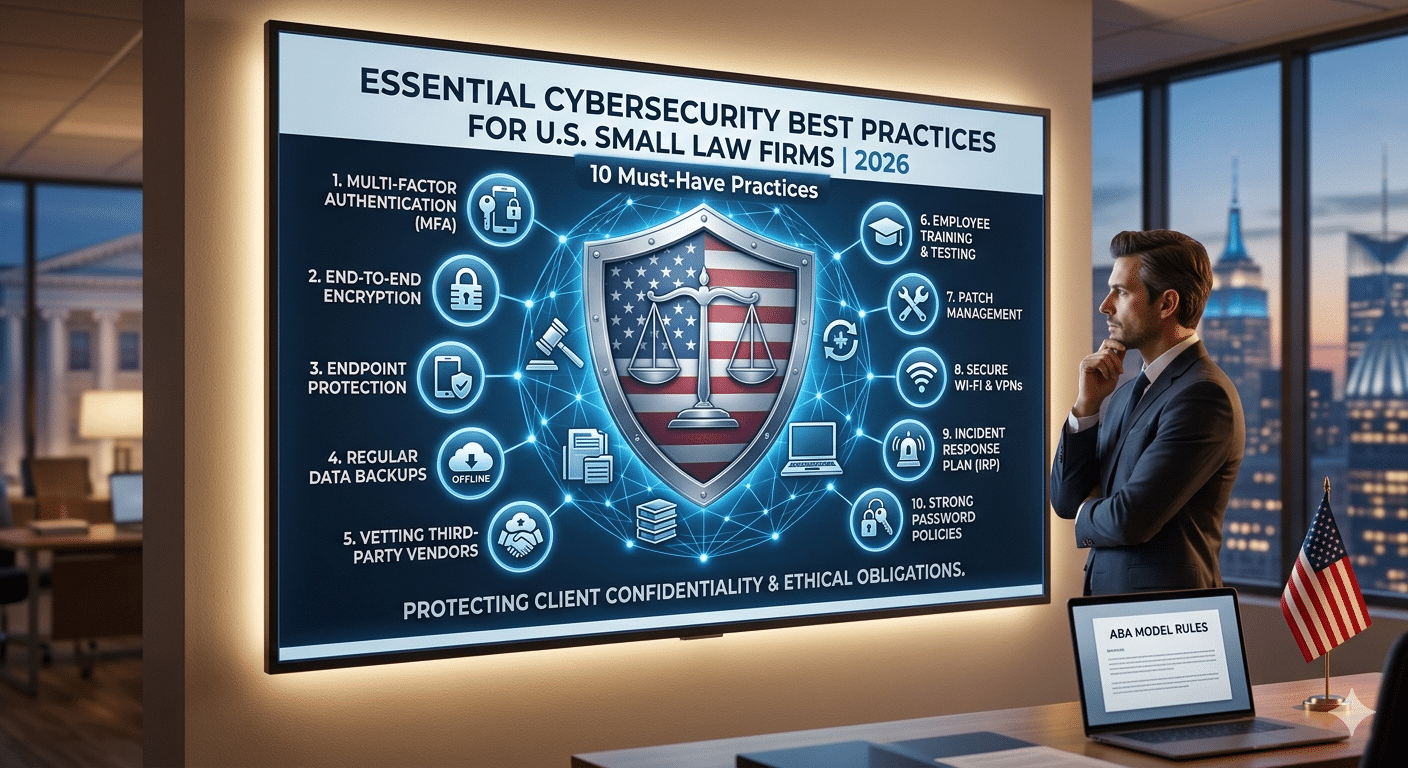
10 Must-Have Cybersecurity Practices
These technical steps map directly to ABA guidance and state ethics rules, providing a framework for “reasonable efforts.”
-
Multi-Factor Authentication (MFA): Mandatory for all email, cloud storage, and remote access.
-
End-to-End Encryption: For both data at rest (on your hard drives) and data in transit (emails and file transfers).
-
Endpoint Protection: Use advanced, AI-driven antivirus and EDR (Endpoint Detection and Response) on all devices, including mobile phones.
-
Regular Data Backups: Maintain encrypted, offline, or “immutable” backups to ensure recovery after a ransomware event.
-
Vetting Third-Party Vendors: Ensure your cloud providers (Clio, MyCase, NetDocuments, etc.) comply with US-specific security standards (like SOC2).
-
Employee Training & Testing: Conduct regular phishing simulations. Your staff is often the first and weakest line of defense.
-
Patch Management: Ensure all software, especially OS and browser versions, are updated immediately to close security gaps.
-
Secure Wi-Fi & VPNs: Prohibit the use of public Wi-Fi for firm business without a firm-approved Virtual Private Network.
-
Incident Response Plan (IRP): Have a written, “break-glass” plan for what to do the moment you suspect a breach.
-
Strong Password Policies: Utilize a firm-wide password manager to eliminate reused or weak credentials.
Making It Work on a Small-Firm Budget
Cybersecurity does not have to be a six-figure investment. Many of the most effective measures—like MFA and staff training—carry low monthly costs but offer high protection.
Furthermore, these measures are now essential for Cyber Insurance. Underwriting requirements have become significantly stricter across the U.S. Most professional liability carriers now require proof of MFA, tested backups, and written security policies before they will issue or renew a policy. Implementing these practices often qualifies your firm for discounted premiums or specialized cyber endorsements.
Final Thoughts: Cybersecurity Is Client Service
Strong cybersecurity is more than a technical hurdle; it is a fulfillment of your Duty of Competence. In 2026, clients—particularly corporate entities and high-net-worth individuals—regularly inquire about a firm’s security posture before retaining counsel. Being able to articulate your firm’s commitment to these 10 practices is a competitive advantage and a powerful differentiator.
Pro Tip for Multi-State Practices: Always align your security posture with the most stringent state bar requirements in the jurisdictions where you are licensed. This “highest common denominator” approach ensures you stay compliant and efficient without managing multiple sets of rules.
Take one action this week: Conduct a quick audit of your email accounts. If Multi-Factor Authentication isn’t turned on, make that your priority. Your clients—and your malpractice carrier—will thank you.
Related podcast: Click here