
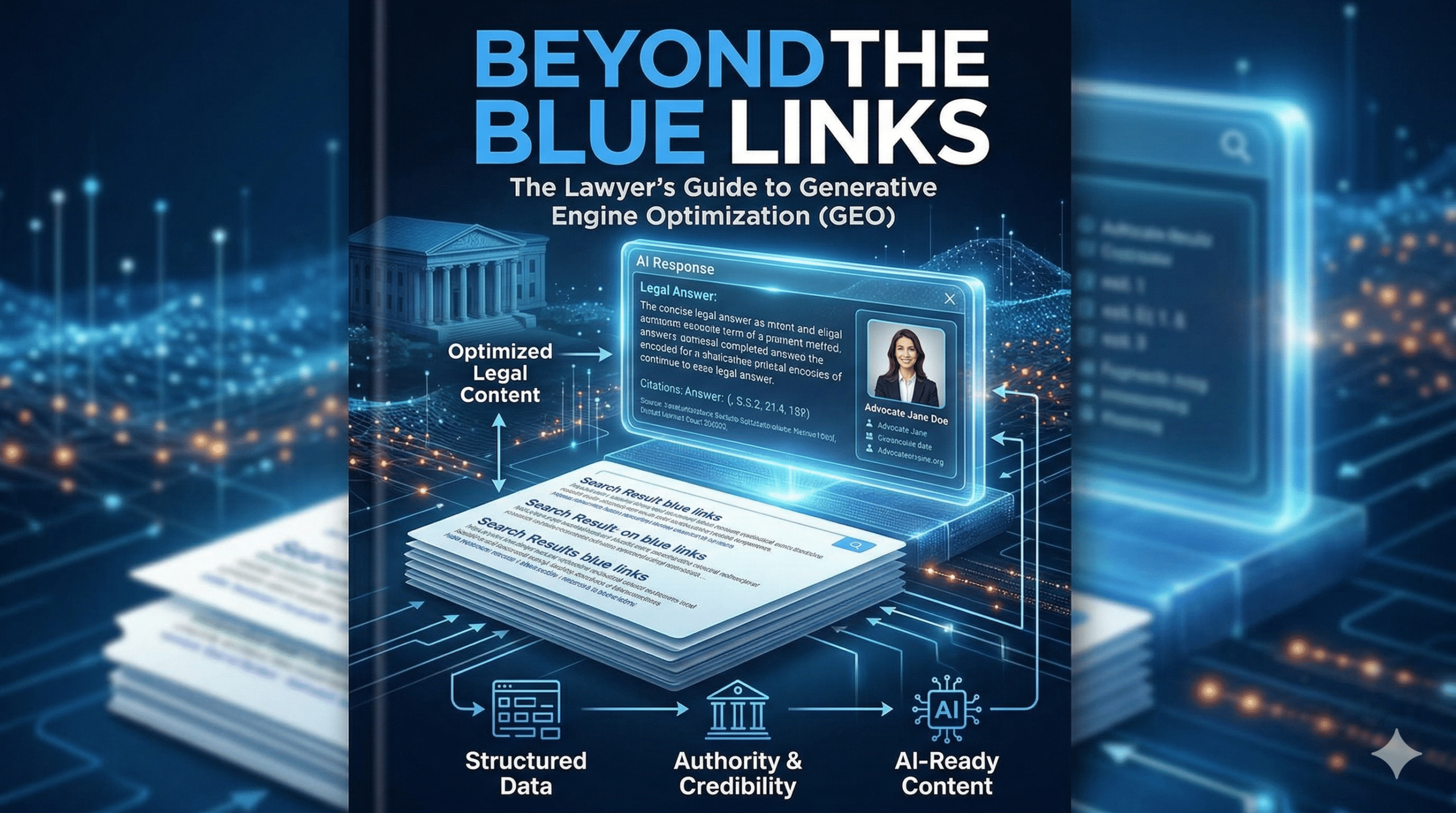
For the last two decades, the formula for law firm growth was simple: rank on the first page of Google. If you held a top-three spot for “personal injury lawyer in [City],” your phone rang.
But the landscape just shifted.
With the rise of ChatGPT, Google Gemini (AI Overviews), and Perplexity, the way potential clients find legal counsel is changing. We are moving away from a world of “search results” and into a world of “generated answers.”
If your law firm isn’t optimizing for AI, you aren’t just losing rank—you’re becoming invisible. Welcome to the era of Generative Engine Optimization (GEO).
What is GEO? (And Why SEO Isn’t Enough Anymore)
Traditional SEO (Search Engine Optimization) focuses on keywords, backlinks, and technical site health to appease an algorithm that points users toward websites.
GEO (Generative Engine Optimization) is the process of optimizing your digital footprint so that Large Language Models (LLMs) like GPT-4, Claude, and Gemini perceive your firm as the definitive authority. Instead of providing a list of links, these engines synthesize information into a single, cohesive answer.
The GEO Goal: You don’t just want to be a link on the page; you want the AI to say: “According to the experts at [Your Law Firm], the statute of limitations for this case is…”
The 5 Pillars of GEO for Law Firms
Recent research (including studies from Princeton and Georgia Tech) has identified specific “optimization levers” that help content get cited by AI engines. For law firms, these five strategies are the most critical:
1. The Authority & Citation Boost
AI models are trained to prioritize “high-authority” sources to avoid hallucinations. For a lawyer, this means your content must be backed by data.
-
The Tactic: Don’t just say “Car accidents are common.” Say “According to the 2024 Department of Transportation report, car accidents in [State] increased by 12%.”
-
Why it works: AI engines favor content that includes citations and statistics because it makes the AI’s generated response appear more credible.
2. The “Expert Opinion” Quotient
AI is excellent at summarizing facts, but it struggles with nuance and “opinionated” expertise. It looks for unique perspectives to add value to its summary.
-
The Tactic: Write deep-dive “Opinion” pieces or “Legal Analysis” on recent local court rulings. Use phrases like, “In my 20 years of experience handling medical malpractice in Florida, I’ve observed that…”
-
Why it works: AI prefers to cite a human expert when a topic is subjective or complex, rather than a generic service page.
3. Structured Data and Schema Markup
While traditional SEO uses schema, GEO relies on it for context. AI engines use “Knowledge Graphs” to connect entities (e.g., your law firm) to locations, practice areas, and specific attorneys.
-
The Tactic: Implement advanced LegalService and Attorney schema. Ensure your “About Us” pages use clear, declarative sentences: “[Partner Name] is a criminal defense attorney in [City] specializing in [Niche].”
-
Why it works: It helps the AI’s “crawler” quickly categorize who you are and what you are an authority on without having to guess.
4. Direct Answer Optimization
When a user asks Perplexity, “Can I sue for a slip and fall if there was no warning sign?”, the AI looks for content that answers that question directly and early.
-
The Tactic: Use the “inverted pyramid” style of writing. Put the answer to the most common client questions in the first paragraph. Use H2 headers that are phrased as questions.
-
Why it works: AI engines are “answer engines.” If you provide a concise, 2-3 sentence answer followed by a detailed explanation, the AI is more likely to use your concise answer as its “featured snippet.”
5. Brand Mention and Digital PR
AI doesn’t just look at your website; it looks at the entire internet. It builds a “consensus” about your firm based on legal directories (Avvo, Justia), news mentions, and social media.
-
The Tactic: Focus on “Off-site GEO.” Get mentioned in local news, contribute to legal journals, and ensure your profiles on third-party sites are consistent.
-
Why it works: If 50 different high-authority sites link your name to “Maritime Law,” the AI concludes that you are the primary authority on that topic.
The “EEAT” Evolution: From Google to AI
Lawyers are already familiar with Google’s E-E-A-T (Experience, Expertise, Authoritativeness, and Trustworthiness). In the GEO world, “Experience” is the most important letter.
AI can write a generic blog post about “How to get a divorce.” It cannot write about “The emotional challenges I saw clients face during high-asset divorces in Travis County Court last month.”
To win at GEO, your content must be “un-AI-able.”
-
Include case studies (anonymized).
-
Include video transcripts of you explaining a concept.
-
Include unique photos from your local courthouse or office.
How to Measure GEO Success
The old metrics (rankings and organic traffic) are becoming “noisy.” If a user gets their answer directly from ChatGPT, they may never click on your site—but they may still call your firm because the AI recommended you.
New metrics to track:
-
Share of Model (SoM): Ask ChatGPT or Gemini, “Who are the top personal injury lawyers in [City]?” and see if you are mentioned.
-
Referral Traffic from AI Engines: Monitor your Google Search Console and Analytics for traffic coming from openai.com, perplexity.ai, or google.com (via AI Overviews).
-
Brand Searches: An increase in people searching for your firm by name often indicates that an AI engine recommended you elsewhere.
The Verdict: Adapt or Be Left Behind
The “10 blue links” are not dead, but they are no longer the primary way high-value clients discover information. They are asking their phones, their browsers, and their AI assistants for legal guidance.
By shifting your strategy from “ranking for keywords” to “becoming an authoritative source for AI,” you ensure that your law firm remains the answer when it matters most.
Is your firm ready for the GEO revolution? Start by auditing your most important practice area page today. If an AI read it, would it find a statistic, a unique expert opinion, and a clear answer? If not, it’s time to rewrite.
Key Takeaways for Your Next Marketing Meeting:
-
Stop producing “thin” content. AI can do that better than you.
-
Focus on citations. Every blog post should cite a law, a study, or a statistic.
-
Own your niche. Don’t just be a “lawyer.” Be the “Philadelphia construction accident specialist.”
-
Optimize for “Conversational Queries.” Think about how people speak to Alexa or ChatGPT.
Want to know how much it will cost for MOREMAX.NET to assist you? View our IT support pricing for law firms