
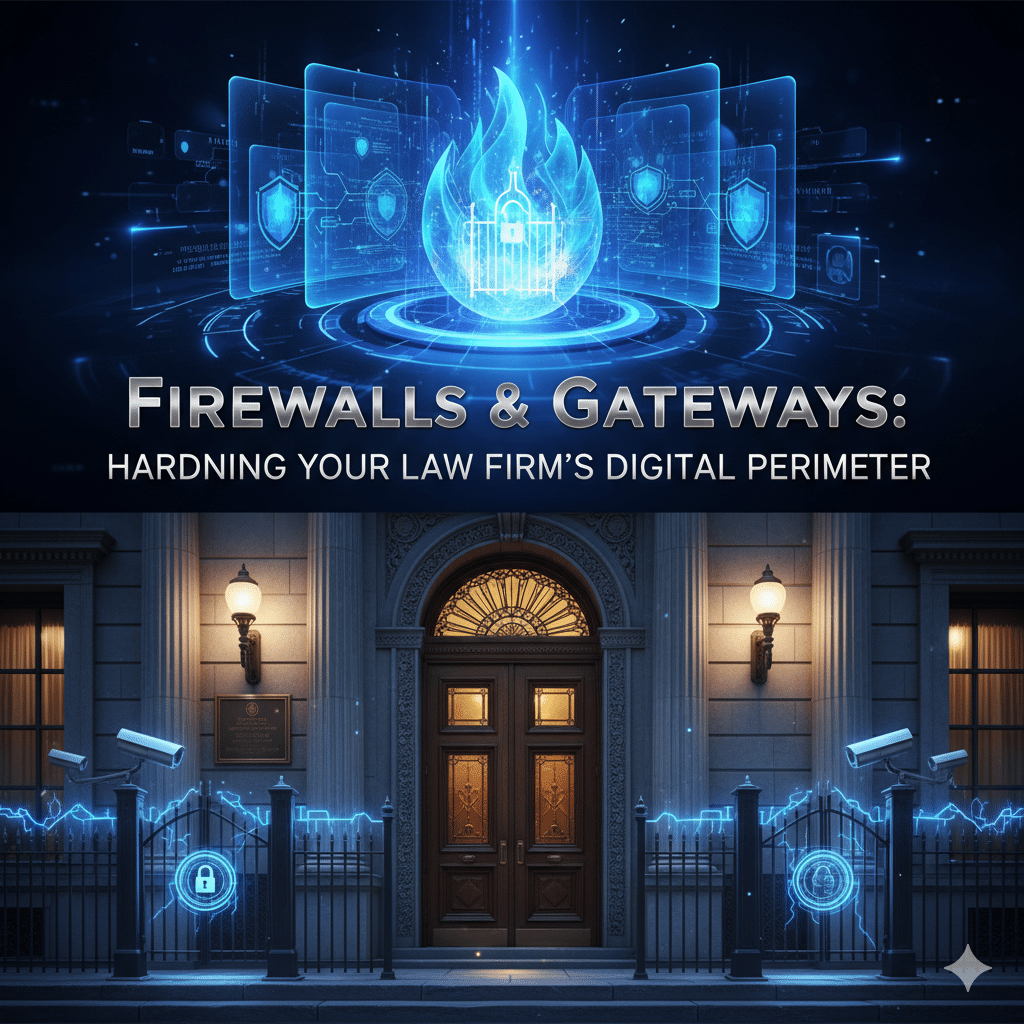
The legal industry’s security perimeter has evolved from locked filing cabinets to complex digital infrastructure under constant attack. For law firms in 2026, a data breach isn’t just a technical failure—it’s a breach of attorney-client privilege and a potential violation of ethical obligations under ABA Model Rules.
This guide will show you how to harden your digital perimeter at its most critical points: the firewall and gateway.
Why Cybercriminals Target Law Firms
Law firms are prime targets for cyberattacks. You’re “data goldmines” with often mid-tier security infrastructure. Your servers contain:
- High-stakes litigation strategy documents
- Sensitive merger and acquisition (M&A) data
- Private personally identifiable information (PII)
- Confidential client communications
This information is highly leverageable for ransomware attacks and corporate espionage. According to the ABA’s recent cybersecurity reports, nearly 29% of law firms have experienced some form of security breach.
1. Upgrade to Next-Generation Firewalls (NGFW)
Why Traditional Firewalls Fall Short
If your firm still uses a traditional firewall that only examines IP addresses and ports, you’re essentially using a screen door to stop a battering ram. Modern cyber threats require next-generation firewalls.
Key Features of Next-Generation Firewalls
Deep Packet Inspection (DPI)
Unlike legacy firewalls, NGFWs inspect the actual content of data packets. This allows them to identify hidden malware even when it’s transmitted through a “safe” port.
Intrusion Prevention Systems (IPS)
These systems act as active sentries, recognizing patterns of known attacks in real-time, including:
- SQL injection attempts
- Brute-force login attacks
- Zero-day exploits
When detected, IPS shuts down these threats before they penetrate your network.
Application Awareness
An NGFW can distinguish between legitimate staff activity (like using LinkedIn) and malicious scripts attempting to exfiltrate data via unapproved cloud applications.
2. Implement Geographic Blocking (Geo-Blocking)
Strategic Traffic Filtering
Does your firm have clients in Eastern Europe or East Asia? If not, there’s likely no reason for your network to accept traffic from those regions.
How to Implement:
Configure your firewall to automatically drop all traffic from high-risk countries where you don’t conduct business.
The Security Benefit:
This simple step can eliminate up to 60% of automated bot attacks and reconnaissance scans before they ever touch your internal systems.
3. Disable Legacy Protocols: Eliminating “Zombie” Vulnerabilities
One of the most common entry points for hackers is through outdated “legacy” protocols—old communication methods never designed for modern security.
Critical Protocols to Disable
TLS 1.0 and TLS 1.1
These encryption protocols are outdated and vulnerable to attacks. Configure your gateway to only allow TLS 1.2 or TLS 1.3.
SMB v1 (Server Message Block)
This old file-sharing protocol was the primary attack vector for the devastating WannaCry ransomware in 2017. It should be disabled across your entire network immediately.
4. Harden Remote Access Gateways
The VPN Double-Edged Sword
With partners and associates working from home, courthouses, and client sites, your VPN gateway is a critical security point. However, standard VPNs can be dangerous: if a hacker steals a lawyer’s VPN credentials, they have a direct tunnel into your server.
Essential Remote Access Security Measures
Enforce Multi-Factor Authentication (MFA)
Multi-factor authentication is non-negotiable in 2026. Even if a password is compromised, the gateway remains locked without the second authentication factor (typically a code from a mobile app or hardware token).
Zero Trust Network Access (ZTNA)
Many forward-thinking firms are moving away from traditional VPNs to ZTNA. Instead of giving a user blanket access to the entire network, ZTNA only grants access to specific applications (like your Document Management System) after verifying:
- The user’s identity
- Device health and security posture
- Current security context
5. Implement Comprehensive Logging and SIEM Integration
Why Logging Matters
A firewall is only as effective as the monitoring behind it. Hardening your perimeter includes setting up centralized logging systems.
The “Black Box” Approach
Your firewall should log every denied connection attempt and suspicious event. This creates an audit trail for forensic analysis if a breach occurs.
SIEM (Security Information and Event Management)
For mid-to-large law firms, connecting firewall logs to a SIEM platform allows artificial intelligence to detect “low and slow” attacks—where a hacker attempts to guess one password every hour to avoid detection triggers.
Data Encryption and ABA Model Rule 1.6 Compliance
Your Legal Obligation
Under ABA Model Rule 1.6(c), lawyers have an affirmative duty to make “reasonable efforts” to prevent unauthorized access to client data.
In 2026, “reasonable efforts” in the eyes of judges and state bar associations includes:
- Maintaining an active, modern firewall
- Keeping security systems patched and updated
- Implementing defense-in-depth security strategies
Failure to maintain adequate cybersecurity can result in:
- Malpractice claims
- Ethics violations
- Loss of client trust
- Regulatory penalties
Your Law Firm Network Security Audit Checklist
Use this checklist to assess your current security posture:
Firewall Assessment
- Is our firewall a next-generation model with active threat intelligence subscriptions?
- When was the last firmware update applied?
- Do we have documented firewall rule reviews scheduled?
Geographic and Protocol Security
- Are we geo-blocking regions where we have no business operations?
- Have we disabled TLS 1.0, TLS 1.1, and SMB v1?
- Are all legacy protocols documented and justified?
Access Control
- Is MFA required for every gateway entry point (email, VPN, client portals)?
- Have we implemented a password policy that meets current best practices?
- Do we have an access review process for departing employees?
Monitoring and Maintenance
- When was the last time we reviewed our firewall’s rule base to delete old, unused permissions?
- Do we have centralized logging enabled?
- Are security logs reviewed regularly?
Conclusion: Protecting Trust Through Technology
Your digital perimeter is the first line of defense for your firm’s reputation and your clients’ trust. By hardening your firewalls and gateways, you aren’t just protecting data—you’re fulfilling your ethical obligations and protecting the confidential relationships that are the foundation of legal practice.
Don’t wait for a breach to discover your gate was left unlatched. Implement these security measures today to ensure your firm meets the cybersecurity standards expected in 2026.
About Cybersecurity for Law Firms
Staying ahead of cyber threats requires ongoing education and vigilance. For more resources on protecting your law practice, consult with cybersecurity professionals who specialize in the legal industry and stay current with ABA guidelines on technology and ethics.