
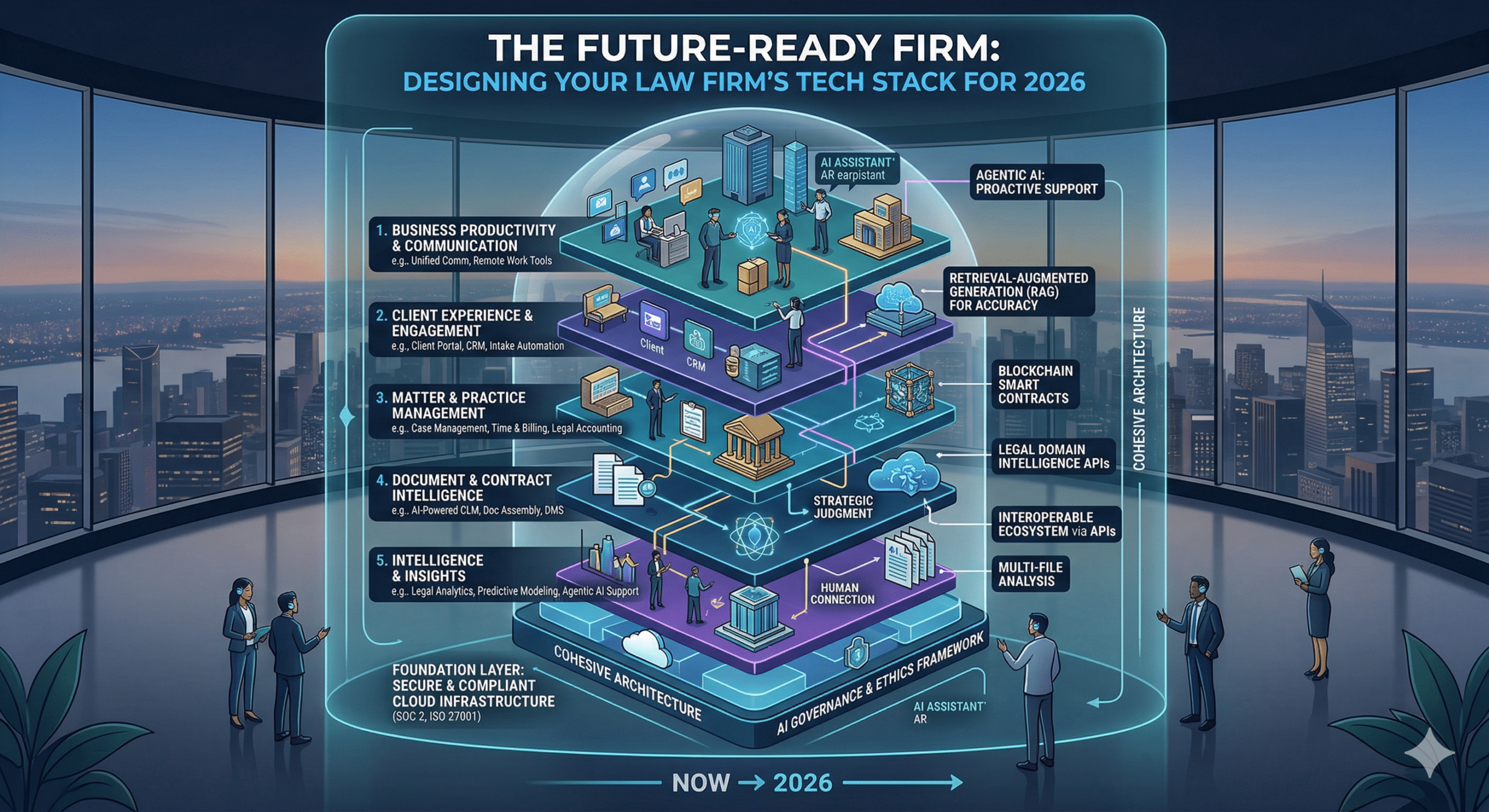
In the legal industry, “innovation” used to be a buzzword. By 2026, it is a survival requirement.
The leap from 2023’s generative AI craze to 2026’s practical application has been swift. We have moved past the era of “playing with ChatGPT” to a landscape where integrated, agentic AI and cloud-native ecosystems define the most profitable firms.
If your firm is still relying on fragmented legacy software or manual administrative workflows, you aren’t just behind—you’re losing margin every single day. Here is the definitive tech stack for a high-performing law firm in 2026.
1. The Command Center: Cloud-Native Practice Management (PMS)
In 2026, your Practice Management System isn’t just a digital filing cabinet; it is the “operating system” of your firm. The best-in-class tools now focus on Open API architecture, allowing them to talk to every other tool in your stack.
-
The Leaders: Clio, MyCase, or Litify (for Salesforce-based firms).
-
The 2026 Standard: Look for a PMS that offers native AI summaries of matters and automated task-triggering based on court deadlines. If your PMS doesn’t sync in real-time with your accounting and document software, it’s time to migrate.
2. The Intelligence Layer: Agentic AI & Advanced Research
By now, every lawyer has access to basic AI drafting. The 2026 tech stack differentiates itself by using Agentic AI—tools that don’t just write text, but perform multi-step tasks.
-
Legal Research: Tools like CoCounsel (Casetext/Thomson Reuters) and Lexis+ AI have moved beyond search; they now provide comprehensive memo drafting and verify citations with zero-hallucination guarantees.
-
Workflow Automation: Tools like Zapier Central or Spellbook allow lawyers to create “AI Agents” that monitor emails for specific client requests and automatically draft the initial response or file the attachment in the correct matter.
3. The Modern Vault: AI-Enhanced Document Management (DMS)
Managing PDFs and Word docs is no longer enough. You need a DMS that understands the content of your files.
-
The Leaders: NetDocuments or iManage.
-
The 2026 Standard: Your DMS should feature automatic entity extraction. This means the system automatically tags documents by party names, expiration dates, and jurisdictional clauses without a human having to type a single tag. This makes your entire firm’s knowledge base searchable in seconds.
4. The Client Experience: CRM and Intake Portals
Clients in 2026 expect an “Amazon-like” experience. They want transparency, instant updates, and mobile-first communication.
-
The Tech: Lawmatics or HubSpot.
-
Why it matters: A robust CRM (Customer Relationship Management) system automates the intake process. It handles the initial conflict check, sends the engagement letter via Docusign, and collects the initial retainer—all before the lawyer even gets on the phone. This reduces “leakage” and ensures no lead falls through the cracks.
5. The Financial Engine: Automated Billing & Predictive Analytics
Hourly billing still exists, but “Value Pricing” and “Flat Fees” are dominant in 2026. Your financial stack must handle both with ease.
-
Billing: LeanLaw or Bill4Time.
-
The 2026 Standard: Integration with Gravity Legal or Confido Legal for automated trust accounting and “Buy Now, Pay Later” (BNPL) options for clients.
-
Analytics: Use tools like Power BI or native dashboards in your PMS to track “Realization Rates” and “Profitability per Matter” in real-time. If you wait until the end of the quarter to see if you were profitable, you’re flying blind.
6. The Perimeter: Zero-Trust Security
With the rise of sophisticated deepfakes and AI-driven phishing, the 2026 legal tech stack must be built on Zero-Trust Architecture.
-
Essential Tech: Ironscales (AI-driven email security), NordLayer (Business VPN), and mandatory Phishing Simulation training for staff.
-
Cyber Insurance Compliance: Ensure your stack includes encrypted client portals. Sending sensitive documents via standard email is increasingly considered a violation of the duty of technology competence.
How to Build Your 2026 Stack
Don’t try to overhaul everything at once. Use the “API-First” rule: Before buying any new software, ask the vendor, “Do you have an open API, and does it natively integrate with my PMS?”
The goal for 2026 isn’t to have the most tools; it’s to have the most connected tools. When your intake talks to your billing, and your AI talks to your documents, you free your lawyers to do what they do best: practice law.
Is your firm ready for 2026? If you’re still fighting with a server in a closet, the time to move is now. The gap between the tech-enabled firm and the legacy firm has never been wider—and it’s only going to grow.