
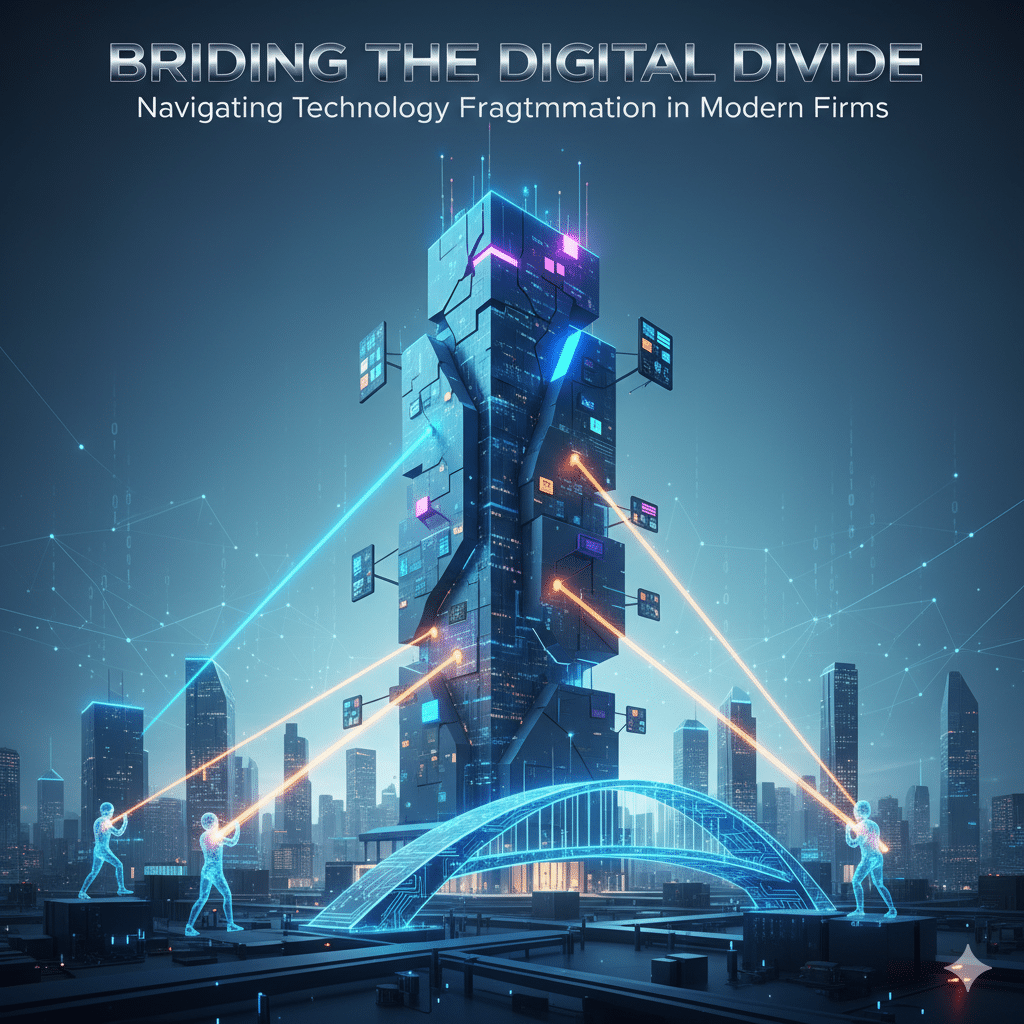
In the race to digitize, many firms have accidentally built a “digital archipelago”—a collection of isolated islands of technology that don’t speak the same language. This phenomenon, known as technology fragmentation, is one of the most significant hurdles to operational efficiency today.
When your firm’s growth is hampered by tools that don’t talk to each other, you aren’t just facing a technical glitch; you’re facing a strategic bottleneck.
Technology Fragmentation: Legacy Systems vs. Cloud
Most firms today operate in a “hybrid” reality. On one hand, you have legacy systems: the sturdy, on-premise workhorses that have housed your data for decades. They are familiar and secure, but often rigid and “heavy.”
On the other hand, modern cloud platforms offer agility, remote access, and rapid innovation. The friction arises when these two worlds collide.
| Feature | Legacy Systems | Modern Cloud Platforms |
|---|---|---|
| Hosting | Local servers (On-premise) | Distributed Cloud (AWS, Azure, SaaS) |
| Accessibility | Office-bound or via slow VPNs | Anywhere, any device |
| Updates | Manual, infrequent, and risky | Automatic and continuous |
| Data Flow | Siloed and “locked” | Open APIs and interconnected |
The challenge isn’t just that cloud is “better”—it’s that maintaining the bridge between the old and the new consumes a massive amount of IT bandwidth and budget.
Challenges of Technology Fragmentation in Modern Firms
Technology fragmentation becomes most visible when you look at how different practice areas interact. A firm is a living organism, but fragmentation turns it into a series of disconnected departments.
- Data Silos: When the litigation team uses one tool and the transactional team uses another, the firm loses its “single source of truth.” This leads to duplicate entries, conflicting client data, and billing nightmares.
- The “Double Entry” Tax: Professionals often find themselves manually moving data from a modern intake form into an aging Case Management System. This isn’t just tedious; it’s a high-risk zone for human error.
- Security Gaps: Every unintegrated tool is a potential weak link. Securing a fragmented environment is exponentially harder than securing a unified ecosystem.
- Inconsistent Client Experience: If your front-end client portal feels like 2024 but your back-end document delivery feels like 1998, it erodes client trust and brand consistency.
How to Solve Technology Fragmentation
Solving fragmentation doesn’t always mean “ripping and replacing” everything at once. It requires a shift in mindset:
- Prioritise Interoperability: When vetting new software, the first question should be, “Does it have an open API?”
- Centralise Data Strategy: Treat your data as a firm-wide asset, not a departmental one.
- Adopt a Middleware Mindset: Use integration layers (like Zapier, Workato, or custom APIs) to force legacy and cloud systems to communicate.
The Bottom Line: Technology should be a force multiplier, not a friction point. By addressing fragmentation, you stop managing tools and start managing results.
Bridging the Law Firm Digital Archip – Podcast: Click here