
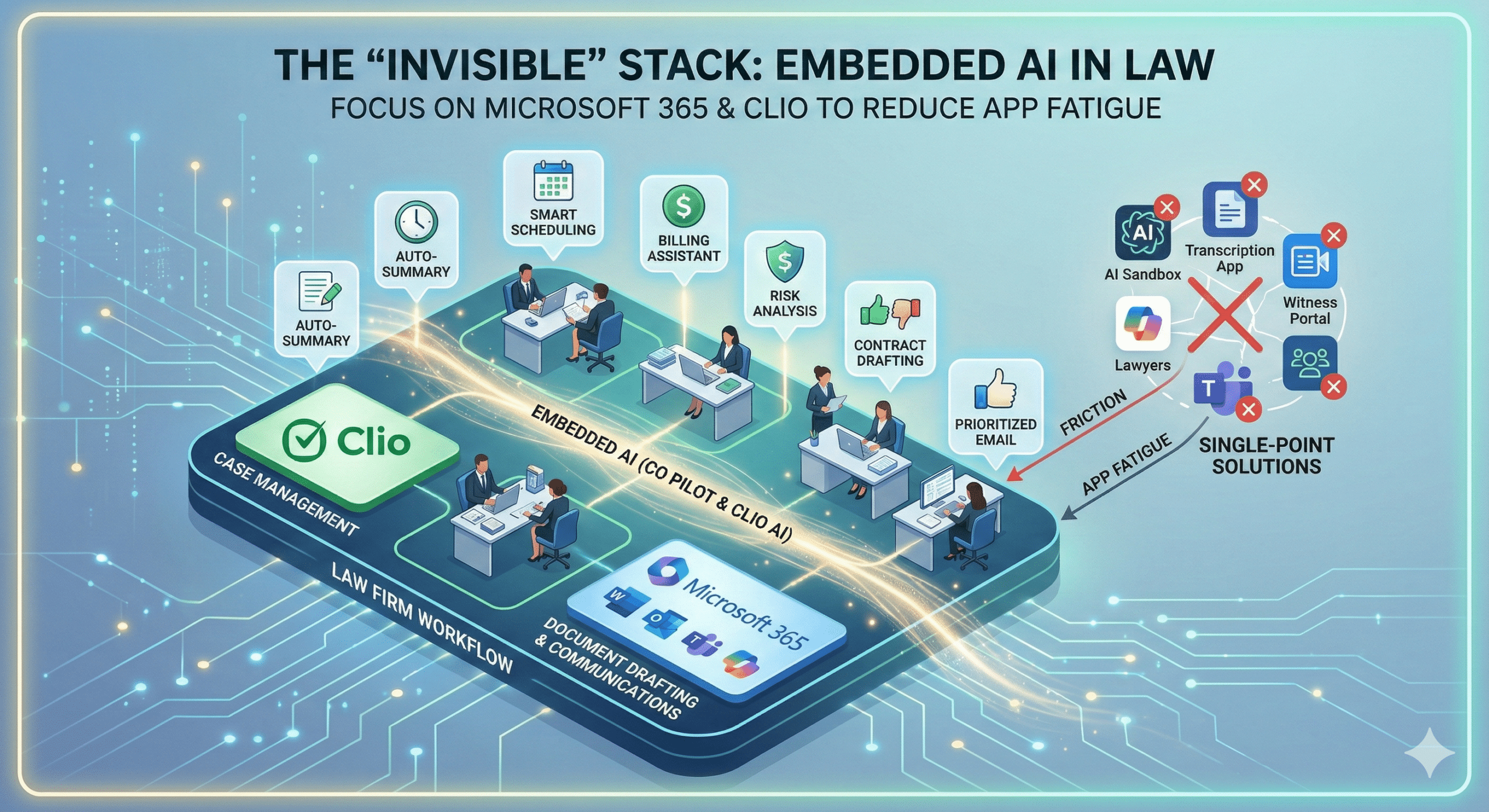
For years, the legal tech industry has followed a predictable pattern: a new problem arises, and a “single-point solution” is launched to fix it. We now have standalone apps for transcriptions, separate portals for witness management, and isolated “AI sandboxes” where you can chat with a PDF—if you remember to upload it first.
The result? App fatigue. Attorneys don’t need more tabs; they need more time. The most effective way to deploy AI in 2026 isn’t by adding another login to your browser, but by adopting the “Invisible Stack.” This is the philosophy of embedding intelligence directly into the tools where your work already happens: Microsoft 365 and Clio.
1. Microsoft 365: From “Drafting” to “Orchestrating”
In the past, using AI for a brief meant copying text from Word, pasting it into a chatbot, and then carefully formatting it back into your document. With Microsoft Copilot, the AI is now a native layer of the operating system and the Office suite.
-
The Workflow: You aren’t “using an AI tool”; you are simply using Word. Copilot can draft a motion by pulling facts from a deposition saved in your OneDrive and cross-referencing your firm’s internal “gold standard” templates.
-
The Invisible Advantage: Because it lives within Teams and Outlook, the AI has “memory” of your communications. It can summarize a three-week-old email thread about a settlement offer or catch you up on a missed meeting without you ever leaving the interface.
-
Security: For law firms, the biggest win is that data stays within the firm’s existing Microsoft tenant, satisfying the stringent security requirements that often kill the adoption of third-party “point” startups.
2. Clio & Manage AI: Context is Everything
A standalone AI might be able to summarize a document, but it doesn’t know that the document belongs to Smith v. Jones or that a hearing is scheduled for next Tuesday. This is where Clio’s Manage AI (the evolution of Clio Duo) changes the game.
-
The Workflow: Instead of manually creating calendar entries, the AI “reads” a scheduling order uploaded to a matter and automatically suggests the deadlines, linking them directly to the case file.
-
Billing Without the Friction: One of the greatest “invisible” wins is AI-assisted billing. Clio can now draft invoices by looking at your activity logs and drafting professional, narrative descriptions that match the client’s billing guidelines.
- The Invisible Advantage: You aren’t “prompting” a bot; you are clicking “Approve” on a task the system already started for you. It turns AI from a research project into an administrative engine.
Why “Invisible” Wins Over “Point Solutions”
| Feature | Single-Point AI Tools | The Invisible Stack (M365 + Clio) |
| Friction | High (Requires data export/import) | Zero (Lives where the data is) |
| Context | Low (Only knows what you tell it) | High (Knows your calendar, matters, & emails) |
| Security | Variable (New vendors = New risks) | Enterprise-grade (Built into trusted platforms) |
| Training | High (Learning a new UI) | Low (Enhances existing UI) |
The Verdict: Stop Looking for the “Killer App”
The future of legal work isn’t a shiny new icon on your desktop. It’s a Word document that drafts itself, an inbox that prioritizes your most urgent client needs, and a practice management system that tracks your time before you even realize you’ve spent it.
By focusing on the Invisible Stack, law firms can bypass the “hype cycle” and move straight to the “productivity cycle.” The goal isn’t to use AI—it’s to have AI work for you, silently, in the background.
Key Takeaway: If your AI strategy requires your associates to open a fifth window to get their work done, you’re losing. Look for tools that disappear into the workflow.
Related podcast: Click here